
The Advice That Never Reaches Your Knees
Almost every woman with lipedema and sore knees has been given the same sentence, usually by someone glancing at her legs rather than examining them: lose some weight and your knees will feel better. She goes away, does the work, and the knees keep aching anyway. After a few rounds of that, most women stop mentioning their knees at all.
We want to offer a different way of picturing the problem. A knee is a hinge, and a hinge only performs when the frame around it stays square. Put a door in a frame that has shifted an inch, and the hinge will start to complain no matter how light the door is. In lipedema, the frame shifts. Tissue builds up in specific places, muscle quietly weakens, and the knee ends up working at an angle it was never designed to hold.
That reframing matters, because it points at things you can actually change. Alignment, strength, and load are all workable. A number on the scale, as we have written before, is a poor guide to any of them.
Why the Knee Drifts Inward
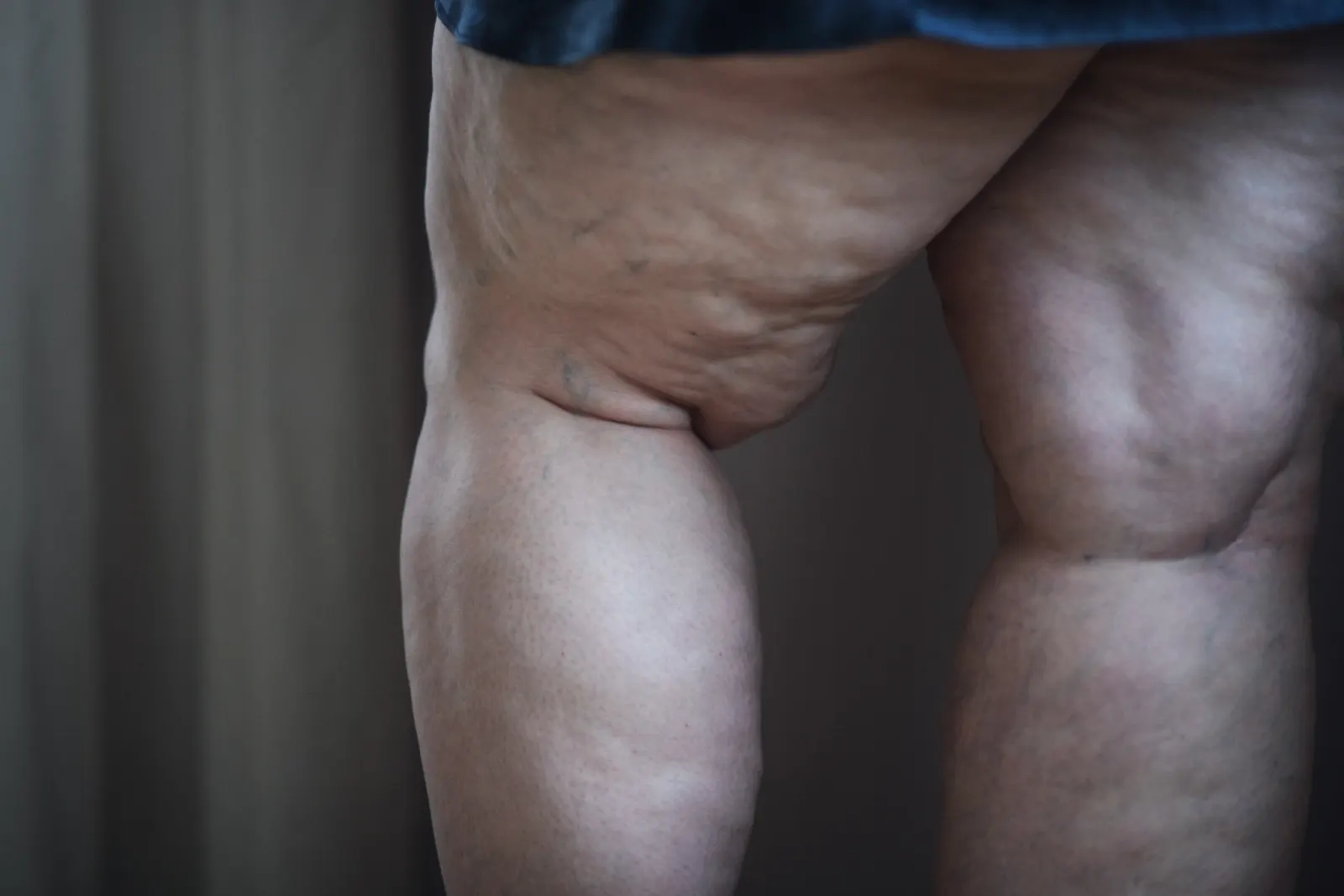
Lipedema tissue does not distribute itself randomly. One of its favorite sites is the inner thigh and the inner knee, and that placement has mechanical consequences. Bulk on the inside of the leg pushes the thighs apart at the top and encourages the knees to travel toward each other, a pattern clinicians call valgus, or knock knee. Many women recognize it from the way their inner thighs and knees rub, or from the wear pattern on their shoes.
At the same time, the muscles that would normally hold the knee straight are often underperforming. Research published in 2025 describes what the authors call a “sarcopenic-valgus cascade” in lipedema, noting that women with the condition show lower leg strength than women with obesity at the same body mass index. In other words, this is not simply about how much a leg weighs. It appears to be a condition-specific weakness, particularly in the quadriceps and the hip abductors, the muscles that stop the knee collapsing inward each time you take a step.
Two more pieces complete the picture. The arch of the foot tends to flatten under sustained load, which rotates the whole limb inward from the ground up. And a prominent fat pad below the kneecap can limit how far the knee comfortably bends, which changes how you climb stairs and rise from chairs. Knee pain in lipedema is common: in one Brazilian population study, well over half of the women who screened positive for lipedema reported it.
Joint Pain, Tissue Pain, or Both
Before you can care for a sore knee, it helps to know which structure is actually hurting, because lipedema gives you two candidates in the same square of skin.
Lipedema tissue pain tends to sit in the soft tissue around the joint rather than in the joint line. It is tender to light pressure, sometimes nodular, often worse when the tissue has been squeezed or knocked, and it bruises with very little provocation. Joint pain behaves differently: it is felt deeper and more centrally, it sharpens with stairs, squatting, or standing up from a low chair, and it may come with stiffness, grinding, or a knee that gives way.
Plenty of women have both at once, and that combination is exactly why the knee gets dismissed. A clinician who presses around the knee, finds tenderness everywhere, and concludes it is all soft tissue will miss a joint that needs attention.
One further thread worth knowing about: hypermobility runs alongside lipedema more often than chance would predict, and lax ligaments give the knee less passive support. We have a whole article on that connection, so go and read it if the flexible-child description sounds like you.
Asking for the Assessment You Actually Need
If your knees hurt, the appointment you want is not a weight conversation. It is a mechanical one. Ask specifically for an assessment of your alignment and your gait: how your knees track when you walk, squat, or step down, whether your arches collapse, and how your hip and thigh strength measure up. Ask whether imaging is warranted if pain is persistent, catching, or one sided.
That conversation lands differently depending on where you are with a diagnosis. If you already have one, lead with it: tell the clinician you have a fat and connective tissue disorder that changes the load on your joints, then ask for the assessment above. That single sentence is usually enough to redirect the visit away from weight and onto alignment and strength.
If you don't have a diagnosis yet, or the clinician in front of you has never raised lipedema, the knee visit doesn't have to be a dead end. It can be the opening. Describe what's specific to your legs rather than just the knee: swelling and tissue buildup that's roughly symmetrical on both sides, pain to light touch or bruising that seems out of proportion to any bump, and a pattern that hasn't moved much with weight loss or gain. Ask directly whether lipedema could be part of what's going on, and ask for a referral to someone who treats it if your own clinician isn't familiar with the condition. Not every GP or orthopedist has been trained to recognize it. Naming it yourself is often what gets a referral moving.
It also helps to arrive with your own evidence about the knee itself. Note which movements provoke the pain, how long stiffness lasts after sitting, whether one knee is worse, and what the pain feels like: sharp and deep, or tender and superficial.
Here is a small thing you can do before you go. Sit in a firm dining chair, and count how many times you can stand fully and sit back down in thirty seconds, without pushing off with your hands. That number is a rough measure of the leg strength driving your knee stability, and repeating it every few months tells you whether your work is paying off. It is also a concrete data point to hand a doctor, which is worth more than a description of how tired your legs feel.
Building Strength Where It Counts
The most common gap we see is not effort. It is aim. Women with lipedema are frequently walking, swimming, and rebounding, all of which are excellent for lymphatic flow, and none of which specifically strengthen the hip abductors that hold the knee in line.
Resistance work does that job, and it does not need to be heavy or gym based:
- Side-lying leg lifts and standing side steps with a light band target the hip abductors directly. Ten to fifteen slow repetitions, a few days a week, is a reasonable start.
- Sit-to-stand repetitions from a firm chair build the quadriceps in the exact pattern that hurts, which is the pattern worth training.
- Water work is ideal while a knee is irritable. Buoyancy takes the load off the joint, the water pressure supports the tissue, and you can build real strength in the pool with almost no impact.
- Calf raises and short-foot exercises support the arch, which quietly influences everything above it.
Two notes from us. Slow beats heavy every time here, because tender lipedema tissue objects to being compressed hard. And if a movement produces sharp, deep, in-the-joint pain rather than honest muscle effort, stop and check it with your clinician or a physical therapist before continuing. Steady, well-aimed work over months is what changes a knee. Nothing about this rewards a hard fortnight.
Nutrition belongs here too, since inflammation raises the volume on both tissue pain and joint pain. Anti-inflammatory eating, adequate protein to support muscle, and attention to nutrient status all matter, and we've linked our supplement line at the bottom for anyone who wants to look at that side of it.
Taking the Load Off, Day to Day
While the strength work builds, a handful of ordinary adjustments can spare the joint a surprising amount of wear.
Footwear first. Supportive shoes with real arch support change knee alignment from the ground up, and flat flip-flops undo a lot of good work. Chair height next: a firm, higher seat is far kinder to a knee than a deep soft sofa, and a folded blanket under a cushion raises a favorite chair for free. On stairs, the old rehab rule still holds: up with the better leg, down with the sorer one, so the stronger knee does the controlling.
Compression deserves a mention, since a garment that ends right at the knee or bunches behind it can dig into an already unhappy joint. If that is happening, it is a fitting issue worth solving rather than a reason to abandon compression, which is doing important work elsewhere.
None of this is a rescue. It is the same principle that governs everything else in lipedema management: take the pressure off, build what is weak, and let time do the accumulating. Knees respond to that patience more reliably than most parts of this condition. The hinge is rarely faulty. It has simply been asked to work in a frame that shifted, and frames can be brought back toward square.
Further Reading
- Hypermobility and Lipedema: What’s the Connection?
- Movement With a Different Purpose
- When Lipedema Pain Flares (Practical Strategies for Relief)